Leaving your keys with a neighbour or a company: what changes the day water gets in
This is not about how much you trust your neighbour. It is about deadlines, evidence and liability, and it gets decided before the incident, not during it.
Published on · A 6 minute read
As long as nothing breaks, the neighbour is enough
He collects the post, glances over when he walks by, warns you when something shows from the street. It is free, it is available, and he knows you. At that level of service, nothing to fault: if that is your current set-up, it works.
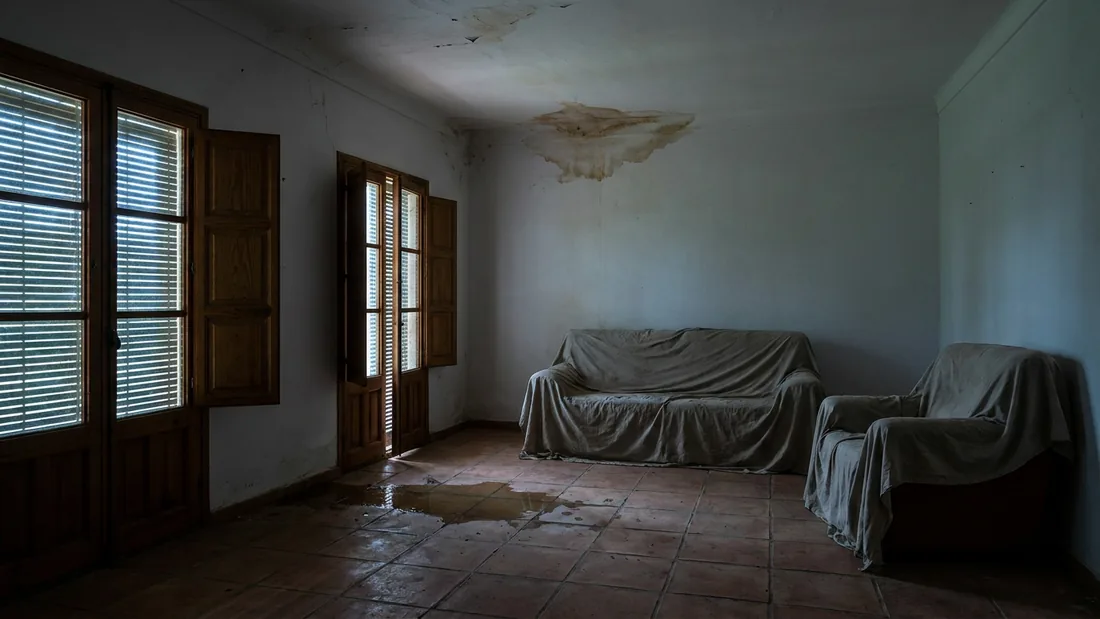
The problem is that water damage does not show from the street. A hose that gives way under a sink, a water heater seal, a slow leak under a terrace: water works in silence, behind a cupboard or inside a partition wall. By the time the stain reaches the ceiling, the damage is often 3 weeks ahead. And that is the day the neighbour arrangement meets its limit, because that day is no longer about doing someone a favour: it is about deadlines, evidence and liability.
7 days to notify, and a file to build
Spanish insurance contract law sets the rule: a claim must be notified to the insurer within a maximum of 7 days of learning about it, unless the policy allows longer. If you are late, the insurer may claim the damages caused by the missing notification.
For an owner who lives 1,800 km away, the real difficulty is not the deadline, it is the starting point: nobody knows when the water started. The insurer will ask 4 simple questions: when was the damage discovered, by whom, what is its likely origin, and what did you do to limit it. A well-meaning neighbour answers from memory, over the phone. A professional visit answers with a record: time-stamped photos, a written description, a certain date, measures taken the same day.
the legal maximum to notify a claim to the insurer, article 16 of law 50/1980
beyond this absence, some Spanish policies already require the water stopcock to be closed
our insurance per claim, including a €30,000 key-loss extension
In short
A neighbour sees what shows from the street. Water damage does not show: by the time the stain reaches the ceiling it is often 3 weeks ahead. Spanish law allows 7 days to notify a claim once you know about it, and the insurer asks for a date, an origin and the steps taken. A spoken account provides none of those, a dated photo report does.
What your policy expects of an empty house
Spanish policies distinguish the main home from the second home, and nearly all of them attach special conditions once the house stands empty for several weeks in a row.
Depending on the company, you will find theft cover reduced beyond a set number of consecutive empty days, an obligation to close the stopcock after as little as 72 hours away, and the general duty to declare that the home is not occupied year round: under the law that is an aggravation of the risk, and keeping quiet about it can cost you the cover. Reread your general conditions and look for 2 expressions: vivienda deshabitada and llave de paso.
This is exactly where a regular, documented visit changes the picture: report after report, it shows the house is looked after, the water off, the sensitive points checked. On the day of a claim, that proven regularity weighs more than any witness account.
Liability, which nobody discusses beforehand
If your neighbour slips on your wet terrace, who covers what? If he hands the key to a passing tradesman, who wrote that down? If he forgets to close the stopcock, who answers for it? These are not accusations, they are questions with no written answer.
A company answers in writing. At Domivaro: insurance of €600,000 per claim, a €30,000 key-loss extension, keys stored in the sealed key cabinet under a coded label with no name and no address, and every key movement logged. Your neighbour has none of that, and it is not his role.
The neighbour stays precious, just not for this
The 2 arrangements do not exclude each other, they simply do not play the same position.
| Criterion | The neighbour | A company |
|---|---|---|
| Daily eye and human bond | Unbeatable | No: 1 to 4 visits a month |
| Dated record for the insurer | An oral account | Written report, time-stamped photos |
| Liability covered in writing | None | €600,000 per claim |
| Small repairs on the spot | As far as he can | Labour included in the plan |
| Cost | €0, plus a debt of favours | From €95 a month, written in advance |
Our recommendation fits in 1 sentence: keep your neighbour as the first pair of eyes and the human link, and hand a professional whatever engages insurance, evidence and liability. The day there is water on the floor, both will be useful, each in the right place.
Neither a neighbour nor a care company can promise you protection against intruders: in Spain that is a reserved activity under law 5/2014, for licensed security companies only. Domivaro carries out no surveillance activity: we maintain, we check, we document.
A question about your house?
The check visit is free and commits you to nothing. We come, we run the 38 points and we send you the report. You see what you are buying before you pay.
3 recurring questions
Can my neighbour stay our contact on the ground?
Yes, and it is a good idea. Many owners keep that link: the neighbour hands us the spare keys against a signed receipt at the start, and he remains the first to flag anything visible from outside. We take the rest: the checks, the reports, the labour and the liability.
What happens if you find damage during a visit?
You receive the time-stamped photos and the written record the same evening, with the likely origin and what was done to limit the damage in the minutes after the discovery. Any intervention beyond the included labour comes with a written quote, approved by you before any work.
Should I tell my insurer the house stands empty?
Yes. Prolonged vacancy is an aggravation of the risk: declaring it protects your cover, hiding it can cost you the cover. Tell them as well that the house is checked every month with dated reports: depending on the policy, that can work in your favour. The final decision belongs to your insurer, not to us.
Sources: article 16 of law 50/1980 on insurance contracts; published general conditions of Spanish insurers, checked on 6 August 2026; our guarantees, detailed on the pricing page.
What to remember
- Keep your neighbour as the first pair of eyes, nothing replaces that.
- Hand a professional whatever engages insurance, evidence and liability.
- Tell your insurer the house stands empty: hiding it can cost you the cover.
Written by Fabrizio and Krystel, Domivaro, Busot. Updated on 6 August 2026.
This article gives general information, checked against the sources cited on the date shown. It replaces neither your insurance policy nor the judgement of your insurer or of a legal professional. Domivaro carries out upkeep and written records of condition, not a private security activity.
Read next
- How much does home watch cost on the Costa Blanca?Key holding from €70 to €330 a year, full care from €95 to €590 a month: the prices we checked on the Costa Blanca, and what each range really covers.
- Gota fría: preparing a house that will spend September alone10 steps before mid-September, the 7 days that count after the episode, and the role of the Consorcio when a flood is declared extraordinary.
