Gota fría: preparing a house that will spend September alone
Between September and November, the Mediterranean brews torrential rain the province of Alicante knows well. A lived-in house bails out within 1 hour. A closed house waits for its owner, or for its next visit.
Published on · A 5 minute read
A gota fría, in plain terms
Meteorologists call it a DANA: a pocket of cold air at altitude meeting a sea that is still warm. On the ground it means very intense, very local rain, able to drop in a few hours what the area usually receives over several months.
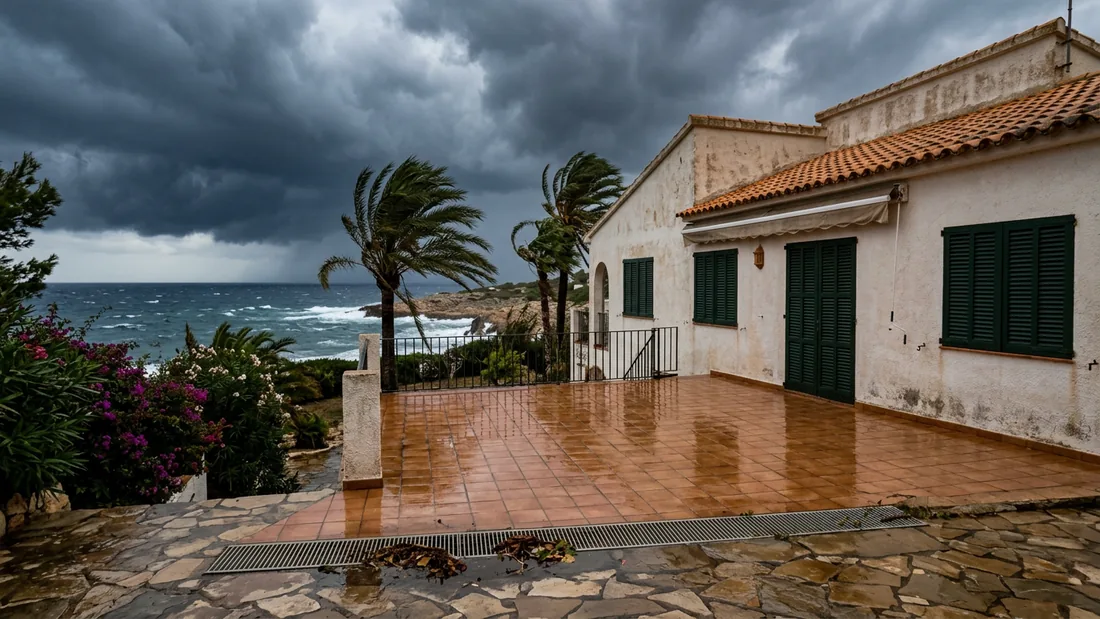
For an occupied house it is a bad moment. For a house closed since July, the danger lies elsewhere: a terrace drain blocked by 2 months of leaves and dust, a gutter overflowing against the facade, and nobody to record anything for weeks. The damage does not come from the rain, it comes from the water that never found its way out.
In short
A gota fría drops in a few hours what the area normally receives over several months. For a closed house the danger is not the rain: it is blocked drains, a stopcock left open and the absence of any record. 10 steps are enough before mid-September, and a claim must be notified within 7 days of discovery.
10 steps before mid-September
Terrace drains
Clear every drain and every overflow. It is the first cause of water getting into closed houses: the terrace fills up and the water crosses the threshold.
Gutters and downpipes
Leaves, pine needles, nests: a blocked downpipe pushes water back under the roof tiles or down the facade.
Outdoor gullies and traps
Lift the grates and remove what the summer left behind. A saturated gully backs up towards the house.
Furniture and parasols
Store or tie down anything that can fly: the gusts of a Mediterranean episode turn a chair into a projectile.
Awnings rolled in
An open awning tears or rips out its fixings. Roll it in and lock the crank.
Shutters closed, vents free
Close the shutters without blocking the ventilation grilles: the house must keep breathing for the humidity that follows the episode.
Pool: level and safety
Lower the level slightly if an episode is forecast, check the overflow, and switch off what needs switching off in the plant room if flooding threatens.
Electricity: choose what stays on
The breaker can trip during the episode. Decide in advance what must stay powered, and what can wait for your return.
Water stopcock closed
Some policies require it after just 72 hours away. Closed, it turns a burst hose into an incident with no consequences.
Dated photos before you leave
Terrace, ceilings, sensitive walls: 10 minutes of photos give you a reference state your insurer will not argue with.
After the episode: the 7 days that count
A claim must be notified to the insurer within a maximum of 7 days of learning about it, article 16 of law 50/1980. For a closed house, everything therefore starts with a prompt record, even without visible damage: water travels, and what is found 3 weeks later makes a poor claim.
the legal maximum to notify a claim to the insurer after learning about it
the absence threshold beyond which some policies require the stopcock to be closed
checked on every Domivaro visit, with time-stamped photos and the report the same evening
If the flood is declared extraordinary, compensation does not come through the flood cover of your policy but through the Consorcio de Compensación de Seguros, a Spanish public body. The condition that matters: holding a policy that is current and paid up at the moment of the loss, even if it does not cover flooding. A house with no active insurance is entitled to nothing. The claim goes through your insurer or directly to the Consorcio, with dates, photos and invoices, and nothing thrown away before the assessment.
What a record visit changes
A report dated the day after an episode fixes 3 things nobody can rebuild afterwards: the true state of the house, the certain date of discovery, and the measures taken to limit the damage. See what the report looks like
A question about your house?
The check visit is free and commits you to nothing. We come, we run the 38 points and we send you the report. You see what you are buying before you pay.
3 recurring questions
Should water and electricity stay off all autumn?
Water, yes, whenever the house stands alone: it is the most cost-effective measure there is, and some policies require it after 72 hours. Electricity, not entirely: the gate, any dehumidifying kit or a fridge left running need power. The right setting is decided room by room, breaker by breaker.
Can the pool overflow badly enough to cause damage?
The real risk is not the volume of the pool, it is the plant room: a drowned pump or a flooded electrical box is expensive. Hence the 2 pre-season steps: overflow cleared, and power cut where needed when an alert is out.
Does my insurance cover the gota fría?
There are 2 layers. Ordinary rain and seepage fall under your own policy, depending on its cover. A flood declared extraordinary falls under the Consorcio, provided a policy is in force. In both cases the file is won with dates and photos: exactly what a record visit produces.
Sources: article 16 of law 50/1980 on insurance contracts; the extraordinary-risk compensation rules of the Consorcio de Compensación de Seguros, checked on 6 August 2026; AEMET terminology for DANA episodes.
What to remember
- Clear the terrace drains and downpipes before mid-September.
- Close the stopcock as soon as the house is alone: some policies require it after 72 hours.
- After the episode, a dated record beats a late visit: the legal clock runs for 7 days.
Written by Fabrizio and Krystel, Domivaro, Busot. Updated on 6 August 2026.
This article gives general information, checked against the sources cited on the date shown. It replaces neither your insurance policy nor the judgement of your insurer or of a legal professional. Domivaro carries out upkeep and written records of condition, not a private security activity.
Read next
- How much does home watch cost on the Costa Blanca?Key holding from €70 to €330 a year, full care from €95 to €590 a month: the prices we checked on the Costa Blanca, and what each range really covers.
- Leaving your keys with a neighbour or a company: what changes the day water gets inThe 7 days Spanish law allows, the dated evidence, the liability: what separates a helpful neighbour from a company on the day there is water on the floor.
