What a house you are not in actually costs
6 items, 3 of them imposed by a text and calculable before you even buy. And the explanation for the rise everybody was hit with in 2025.
Published · 7 minute read
The bill that went up everywhere, and that nobody explained to you
If your waste fee jumped in 2025 or 2026, it is neither your town hall helping itself nor a mistake. It is a national law, and it has a date.
Article 11.3 of Spanish waste law 7/2022 requires local authorities to set a specific, differentiated and non-deficit fee reflecting the real cost of collecting, transporting and treating waste, including the after-care of landfill sites once closed, and public information campaigns.
The words that matter are non-deficit. Until then many towns billed a fraction of the cost and covered the rest from the general budget. That is no longer allowed.
And the text sets a deadline: 3 years from the law coming into force. It is dated 8 April 2022, published on the 9th, in force on the 10th. The deadline was therefore 10 April 2025. That is why ordenanzas fiscales were revised across Spain between 2024 and 2026.
In short
6 items make up the year: 3 are fixed by a text, IBI, the waste fee and modelo 210, and can be worked out in advance once you know the cadastral value. The other 3 are negotiable. The waste fee rise comes from article 11.3 of law 7/2022, which required towns to charge a cost-covering fee by 10 April 2025 at the latest.
The 6 items of your first year, and which ones are negotiable
The useful question is not how much, it is: what does a text impose, and what depends on you.
| Item | Set by | What determines it | Where to check yours |
|---|---|---|---|
| IBI | A text | The town hall votes the rate, the State sets the cadastral value | Your Suma receipt, tipo de gravamen line |
| Waste fee | A text | Law 7/2022 article 11.3: it must cover the real cost | Your town's ordenanza fiscal |
| Modelo 210 | A text | Calculated on the cadastral value, rate depending on your country | Your cadastral value at the Cadastre office |
| Home insurance | The market | Negotiable, and the unoccupancy clause changes everything | Your policy wording, the word desocupada |
| Community fees | The market | Voted at the general meeting, by your share coefficient | The minutes of the last general meeting |
| Water and power at rest | The market | The standing charge is due even with no consumption | Your last 2 bills, the standing charge line |
The first 3 items are set by a rule and are not up for discussion. On the other hand they can be worked out in advance, even before buying, as soon as you know the property's cadastral value: it is on the seller's IBI receipt.
The last 3 are negotiable, and that is where almost all the difference lies between 2 owners of comparable houses.
3 dates that shape the year
Read in the texts on 7 August 2026.
The charging date for IBI. Whoever owns the property that day pays for the whole year, article 75 of the consolidated local finance act.
The deadline law 7/2022 gave towns to bring their waste fee up to real cost. It is the cause of the recent rises.
The end of the tax year for the non-resident's modelo 210, and the theoretical due date of the empty home surcharge.
What an empty house costs anyway
This is the line owners discover by reading it on their bank statement.
The standing charge on electricity and water is payable without using a single litre or kilowatt. It depends on the contracted power for electricity and on the meter size for water. A house empty 7 months a year pays 12 months of standing charge.
Cancelling is almost never the right move: reconnection means a new contract, and a new contract requires the occupancy title. What does work is reviewing the contracted power: many houses still carry a rating sized for building work or for a family of 6.
Community fees keep running too. The amount is voted at the general meeting and shared by your unit's coefficient: ask for the minutes of the last meeting before you buy, not after. That is where the works already voted, and billed to you the following year, appear.
3 mistakes we see every year
Each one costs more than the item it claims to save on.
Turning the water off when you leave
With no water the traps dry out within weeks and drain smells come up through the whole house. Worse, several insurance contracts require the opposite, a full draining of the system, which is not the same as closing a tap.
Waiting for a receipt that never comes
The IBI collection period is published officially: it does not depend on a letter reaching you abroad. Once the deadline passes a surcharge is added, then enforced collection. A direct debit settles it once and for all.
Insuring as if it were a main home
A house lived in a few weeks a year is not insured on the same terms. It is not a question of price, it is a question of clause: the word to look for in your policy is desocupada.
What we do with this
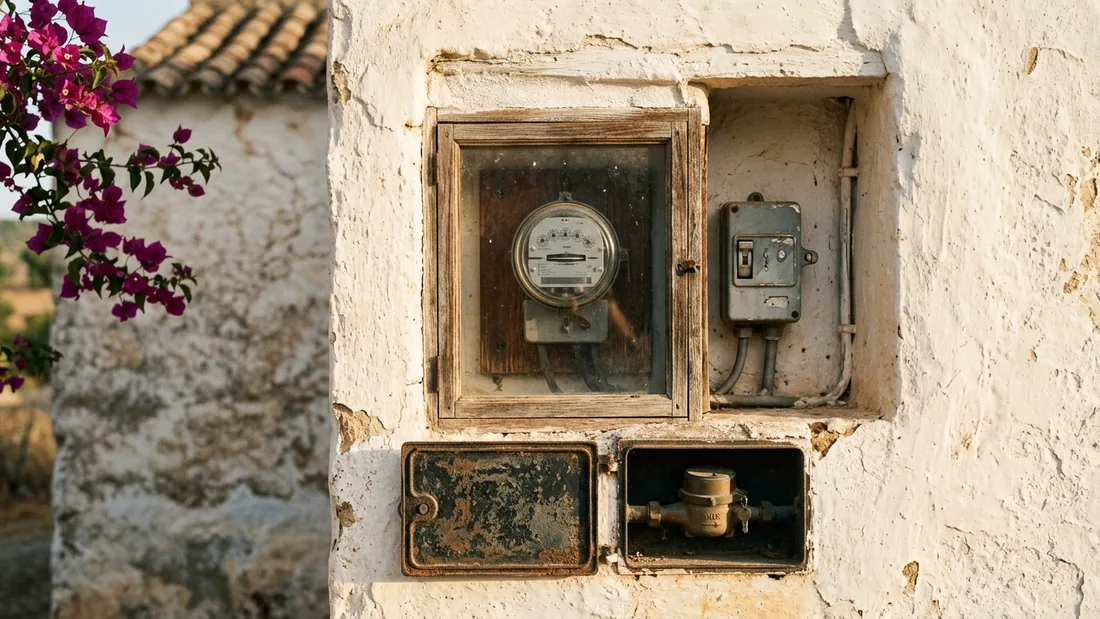
Reading the water and electricity meters is one of the 38 points, on every visit, photographed and dated. It serves first to catch a leak or an appliance left running, which happens more often than people think. But after a year it also gives you the real curve of what your house consumes when nobody is in it. That is the one figure you will not find on any website.
A question about your home?
The check visit is free, with no commitment. We come, we check the 38 points and we send you the report. You see what you are buying before you pay.
4 questions about the annual cost
Why has my waste fee doubled when I am hardly ever there?
Because law 7/2022 requires a fee that covers the real cost of the service, not individual usage. The collection service exists and is funded whether the house is occupied or not. Some towns do provide reductions for lightly occupied homes: they are set out in their ordenanza fiscal, and you have to apply for them.
Can I cancel the electricity over winter to save the standing charge?
You can, but reconnection means a new contract, and a new contract requires the home's occupancy title. Without it the supplier is not allowed to connect you. Lowering the contracted power is almost always the better deal.
When do I pay IBI if I have just bought?
The tax is owed by whoever owns the property on 1 January. If you buy during the year, the seller owes it for the whole year unless the deed says otherwise. Have the point spelled out at the notary's office, it takes 1 line.
What does a second home cost in total each year?
There is no honest answer without your cadastral value, your town and your property. The 3 items fixed by law are calculated exactly from those, and the other 3 are read off your own documents. That is the point of the right hand column in the table above.
Sources: Spanish waste law 7/2022, article 11.3, consolidated text; Consolidated local finance act, article 75, the IBI charging date; Valencian law 3/2004, article 32.3, occupancy title and utility suppliers; Cadastre electronic office, cadastral value lookup. All opened on 8 August 2026.
What to remember
- 3 of the 6 items are fixed by a text and can be calculated before buying, from the cadastral value.
- The waste fee rose because law 7/2022 required a cost-covering fee by 10 April 2025 at the latest.
- The standing charge on water and electricity runs all 12 months, even with no consumption.
- Cancelling a meter forces a new contract, which requires the home's occupancy title.
Written by Fabrizio and Krystel, Domivaro, Busot. Updated 7 August 2026.
This article gives general information, checked against the sources cited on the date shown. It replaces neither your contract nor the advice of your tax adviser, your insurer or a legal professional. Domivaro provides maintenance and condition reporting, not a private security or tax advisory service.
